

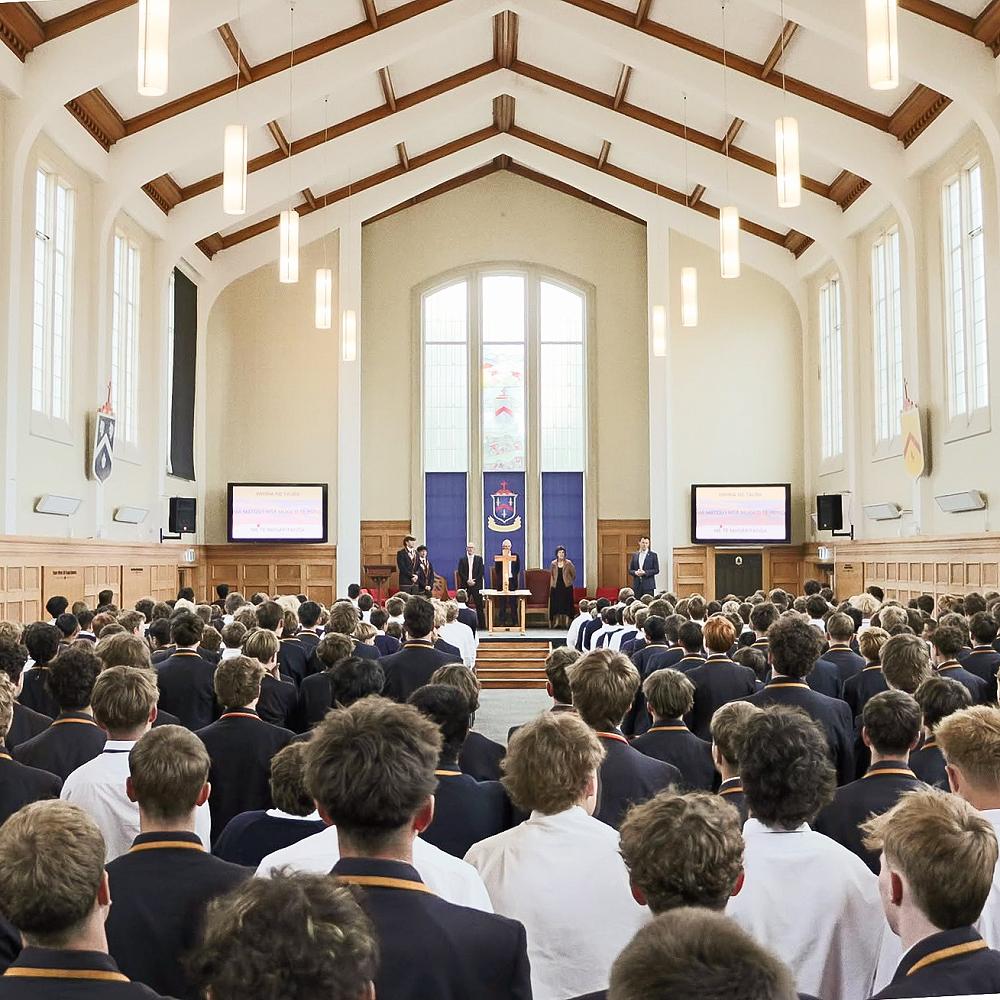
For the past two days, I have been at the annual Presbyterian Church Schools’ Conference. This year, we were hosted by Solway College, a girls’ boarding school that was founded in Masterton in 1916. The theme for the conference was Hei Piringa Mō Tātou, piringa meaning refuge. The time in Masterton was an opportunity for chaplains and principals to reflect on how we weave together special character and Te Tiriti o Waitangi partnership to ensure our schools are places where young people find belonging, opportunity, care and hope.
In a week when wintry weather buffeted much of the country, it was warming to come together in the beautiful whenua of the Wairarapa, amidst the leafy, quiet grounds of Solway. The college was founded at a busy time for the Presbyterian Church, as a network of church schools was established across the country. These emerged after the government made education secular under the Education Act of 1877, and were encouraged by the successful establishment of the Catholic education system.
Rangi Ruru was the first Presbyterian school established in New Zealand, founded in 1889. A bubble of schools was then established during the First World War: Iona (Hawke’s Bay) in 1914, and Columba in 1915. Then, in 1916, Scots (Wellington), St Andrew’s (Christchurch), and Solway. Finally, in 1918 the vision for our college was realised, as was that for Queen Margaret in Wellington in 1919. To round out the Presbyterian schools, St Oran’s in Lower Hutt, Lindisfarne in Hawke's Bay, and St Kentigern’s in Auckland were all established after the Second World War.
Thus, a network of Presbyterian schools, albeit loosely affiliated, was completed. What connects us is a focus on a well-rounded education with an underlying Christian ethos within the Presbyterian Reformed tradition, our ‘special character.’
One of our keynote speakers, the Reverend Ryhan Prasad from Wellington, referred to the ‘great surge of shared learning’ that defined this period, not just as the aforementioned schools were established, but also by the founding of Māori schools by the church: Turakina Māori Girls’ College in 1905, Maungapōhatu in 1918, and Te Whaiti Māori Agricultural School in 1937. Reverend Prasad talked about this period as a deliberate vision of Māori and Pākehā learning enacted side by side by the church in strong Christian character.
The Reverend Alexander Whyte, a Presbyterian minister in Port Chalmers, was an influential figure in the establishment of many of our schools. He helped establish Iona when based in Hawke’s Bay, and Columba when he moved to Otago. He then focused his energies on a boys’ college and initially considered a site at Waikouaiti. This plan was sidelined in April 1917 when Margaret and Agnes McGlashan, the unmarried daughters of John, offered their home and land to build a boys’ college. The Otago synod gratefully accepted the offer and set in motion plans to open our school.
As early as 1847, John McGlashan had set down his vision that the college was to be ‘conducted on Christian principles’. This is the special character that we cherish and maintain at the core of all that we do almost 180 years later.
Our school motto honours our Presbyterian heritage while pointing forward. Although we don’t have a record of it, we believe our crest and motto were adopted at the school’s opening in 1918: Lex Domini Lux Mundi. The Law of the Lord is the Light of the World. He Atua He Marama. The motto is the foundation for our vision, mission, and values. It encourages us to grow in integrity, empathy, and courage and reflects our faith and ongoing commitment to nurturing character and potential.
Chapel and worship provide regular opportunities for reflection, participation and spiritual growth, as do the Christian Studies lessons the junior and middle school students engage in. Outside these communal moments, our values also manifest our special character. These are rooted in our Presbyterian heritage, and by living them, we meaningfully shape the hearts, character, and outlook of our young people.
Living our values of Excellence, Respect, and Manaakitanga makes our special character tangible. It becomes real through the daily culture, relationships, and actions of everyone in our community. That said, when we base our special character on values or service alone, we’re not that different to other schools. As Reverend Prasad urged, it's in the telling of our shared stories that we continue to grow together. These are our origin stories, at the heart of which is our Presbyterian heritage and the activities of the Presbyterian Church in New Zealand from the mid-nineteenth century.
One of many draws for me in coming to John McGlashan College was our special character. I see how important it is to the essence of who we are. It informs where we are going and how we set about achieving our vision for our young people. This is what I was reflecting on as I left Solway. We live our values in all that we do, rooted as they are in our unique heritage, but we also need to tell our stories. It’s these that speak of what we value as a Presbyterian Church School.
Dr Aaron Columbus
Principal | Tumuaki
 Open Event Registration - Interested in enrolling?
 Employment opportunities - click if you're interested in working at McGlashan.