


I read a concerning article about looksmaxxing on the RNZ website this week. Looksmaxxing is a social media trend that encourages young men to make themselves as attractive as possible. This is often achieved by quite extreme activities, which are promoted by social media and online influencers. Dr Simon Copeland explains that looksmaxxing reinforces ‘terrible stereotypes about what men should be and what they shouldn’t be.’ As he goes on to positively argue, looks are entirely subjective: ‘We all have good looks in different kinds of ways, and so the better thing is to be able to focus on what works for you, rather than believing in some particular perfect ideal.’ These are the sorts of counter-narratives that we need to encourage with our young people.
It's hard being a teenage boy in 2026. We recognise this reality and have been thinking a lot about character and positive masculinity. Shifting definitions and expectations of masculinity and pervasive online pressures make this a complex landscape to navigate. It’s important we don’t shy away from the discussion, and that together with home, we remain curious and steadfast in our determination to support our boys to be their authentic selves. Honesty and openness is and will always be the disruptor.
We’re in the process of articulating a coherent, visible framework for character formation and positive masculinity. Key to this is understanding the experiences of our boys, and the expectations they perceive of themselves as young males. There are a lot of unwritten rules about how they should act, look, and handle their emotions. We need to know what it’s really like to navigate those expectations. Rather than assuming their views for them, it seems obvious and respectful that we ask the boys about this.
To that end, this week, all students in Years 9-13 completed a survey. This was based on a framework developed by the Adolescent Man Box project in Australia, the first study to focus on attitudes towards masculinity among Australian adolescents. The resultant report from the Australian project highlights ‘promising signs’ and ‘critical challenges’ that require addressing to support boys in leading ‘fulfilling lives.’
The survey questions were structured to understand respondents' levels of agreement with a set of tightly defined and rigid rules about masculinity. The Adolescent Man Box survey was recommended to us by Ingrid Howren at Brighton Grammar School in Melbourne. In a recent article, Ingrid explained Brighton Grammar’s approach to character education and positive masculinity:
’We want our boys to understand who they are, what they stand for, and to have the confidence to live according to those values. We need them to stay motivated, engaged, and, most importantly, to value relationships. Feeling connected to others – whether it’s their peers, families, or the wider community – is crucial for their growth and wellbeing.’
The Adolescent Man Box survey is used at Brighton Grammar to measure the impact of their character programmes. This is how they know whether they are ‘shifting the dial.’ The Man Box survey is based on four pillars, and each presents a series of statements about masculinity that respondents are required to indicate their level of agreement with. For example, ‘No matter what happens, a teenage boy should seem strong to others’, or, ‘A teenage boy should be able to take teasing from his friends, even if it’s mean or degrading.’
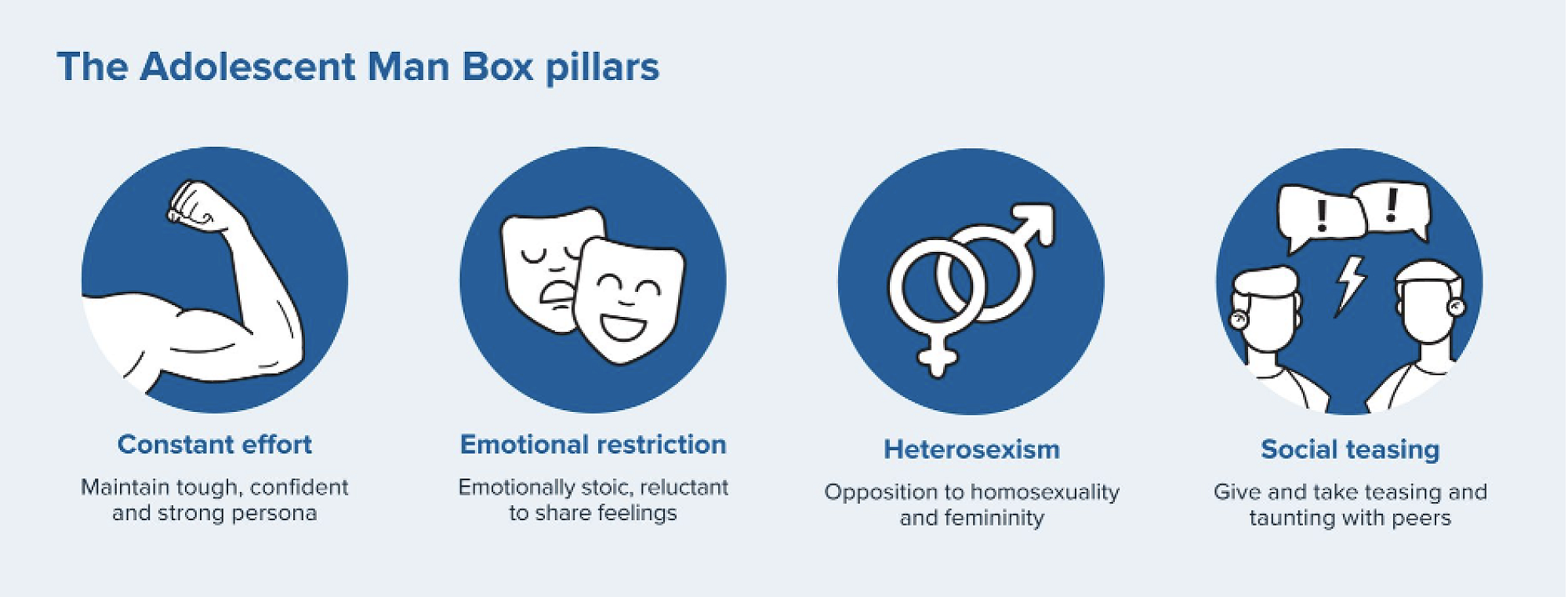
The Australian Man Box survey report, which was conducted with 1,401 young people aged 14-18, presented both reasons for hope and challenges to be confronted.
Reasons for hope:
Most boys feel comfortable showing vulnerability and openly supporting one another.
The vast majority champion equal rights for girls and actively oppose sexist behaviours and harassment.
Teens trust parents and real-life mentors over online influencers to shape their views on masculinity.
Despite facing societal pressures, the majority of boys maintain a positive outlook on their future.
Challenges to confront:
Internalising the pressure to appear tough links directly to harmful behaviours and lower well-being.
A concerning number of boys express homophobic or transphobic views.
Exposure to pornography can warp boys' understanding of relationships.
Despite poor mental health, many boys refuse to seek emotional support.
These are hard subjects to talk about, but we have to talk about them. The survey that we conducted this week (responses were anonymous and the data is for internal use only) gives us a starting point to understand the expectations our boys perceive of themselves as young men. It gives a starting point to challenge pervasive negative narratives and support them to be their authentic selves, as we begin a more intentional approach to character education.
An essential aspect of this work is bringing parents and whānau into the conversation as partners. We need to support and challenge each other to lean in with curiosity and absence of judgement. As Ingrid Howren argues, ‘by coming together – as parents, educators, and community members – and aligning our efforts, we can create lasting, meaningful change.’
Dr Aaron Columbus
Principal | Tumuaki
 Open Event Registration - Interested in enrolling?
 Employment opportunities - click if you're interested in working at McGlashan.