

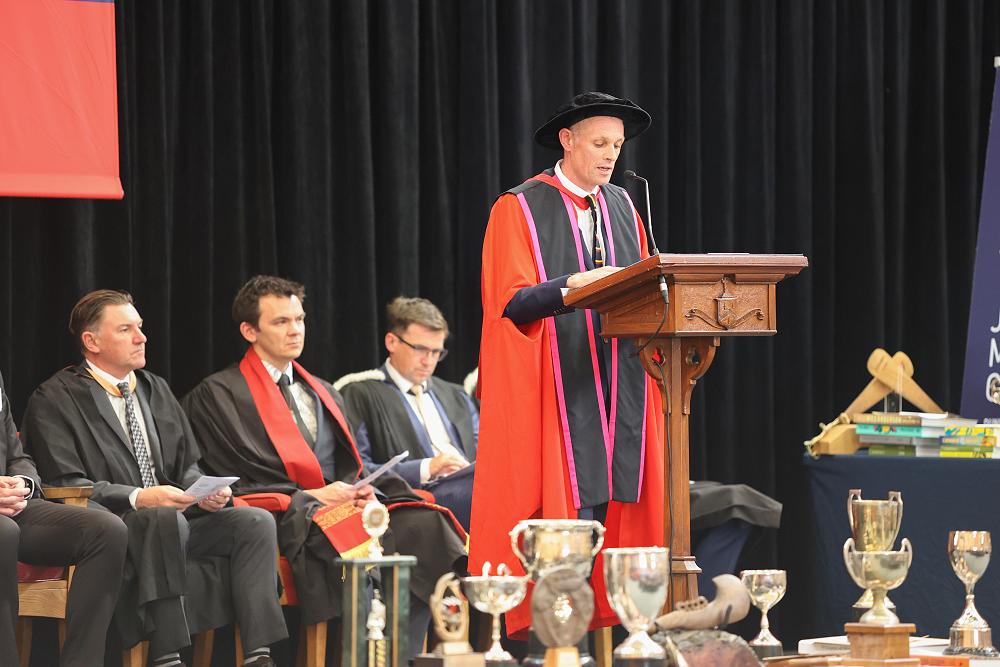
This week’s foreword is a transcript of Dr. Columbus’ speech at the Senior Prizegiving.
In March of 1939, a series of celebratory events was held to mark the 21st anniversary of our college. The Old Collegians organised the first event, a campfire gathering at Flagstaff on 18 March. The whole school was transported there, where, around a huge fire, they saw a mock trial, had a ‘stalking competition’, set off fireworks, ‘shuddered at ghosts’, and had a 'splendid supper.'
At the anniversary dinner on 22 March, The Reverend Dr. J. Dickie, congratulated the school on twenty-one years of ‘vigorous, healthy life.’ He argued that ‘the true test of a school is the sort of boys or girls it turns out as its general average product - not the number of scholarships it gains.’ In reference to examinations, ‘no boy or girl,’ Dickie continued, can do them consistently well without ‘industry and a well-disciplined mind and will’. All three are essential to character building and success in the 'greater and more testing battle of life’, he shared. A sentiment that we would agree wholeheartedly with at our school today, especially on this night when we celebrate the achievements of our boys.
The ‘more testing battle of life’ had literal resonance for the school community by the end of the 1939 academic year, war breaking out in Europe in early September. The editorial in the same school magazine hints at the strong sense of belonging Old Collegians felt to the college, many attending morning prayers at school on the day before leaving Dunedin for active military service. The ‘full and useful routine’ of school kept the community occupied, though. The magazine’s editor took reassurance in the ‘knowledge that, whatever calls may in future be made...we shall be the better fitted to answer them if all the opportunities of School life have been well used.’
A look at the prefect group of 1939 bears out the intention that all the opportunities of school life were well used. Four of the six prefects would go on to active military service during the war, their names recorded on the roll of honour in our chapel. Thankfully, they all returned safely to New Zealand.
C.D. Baker encapsulates a McGlashan student taking full advantage of the opportunities of the college, experiencing an incredibly successful final year. In sports, he won the 100, 200, and 440-yard sprints at the school athletics day, alongside senior high jump, long jump, and a new school record in the 120-yard hurdles. At the inter-schools athletics meet, he claimed the high jump record. He played rugby for the First XV and cricket for the First XI.
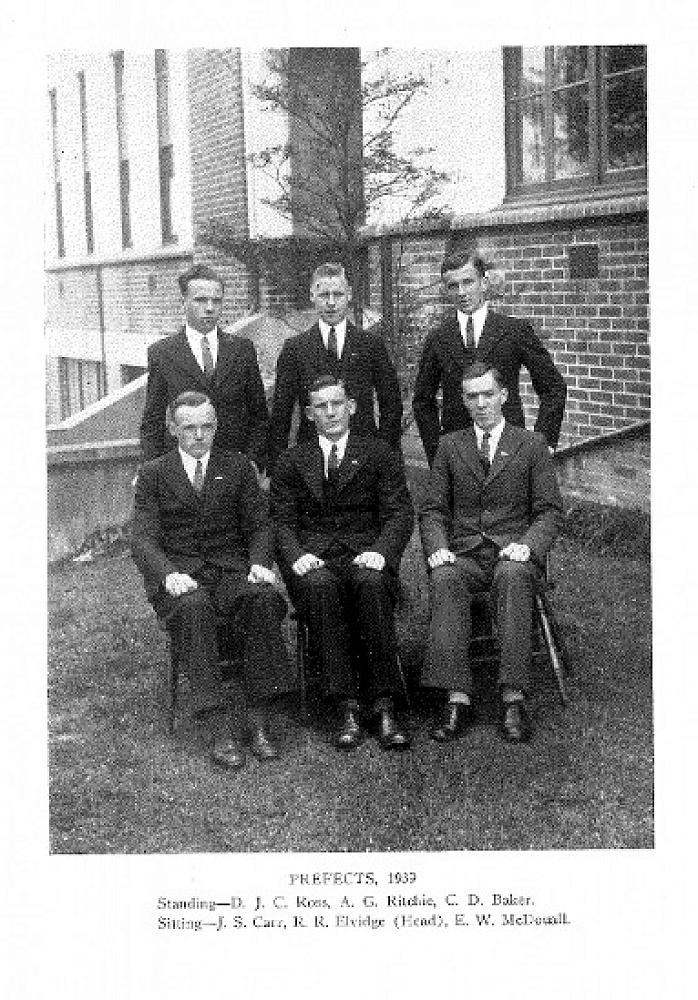
In the cultural sphere, Baker participated in a debate series between senior students and Old Collegians. He was awarded the senior essay prize at the end-of-year prizegiving, gained the Higher Learning Certificate in the national examinations, and was the senior school Dux for 1939. As the world took a dark turn towards the end of the year, Baker likely took confidence and certainty from the ‘full and useful routine’ of school life. Equally, his experiences and successes no doubt ‘fitted’ him to answer whatever challenges called after leaving the school gates, particularly those overseas at war.
In his speech at the prizegiving, the Headmaster, Robert McNab, reported a successful year in ‘examinations, athletics, and health’. Although I have only been in post for close to a month, as I look back over the year, I too can report a successful year. Although, and thankfully, we are not under the cloud of a global war, the world does feel chaotic and uncertain. Our young people feel this, but they are also served well by the routines and rigours of life at McGlashan. We maintain incredibly high expectations of our students and expect that they maintain high expectations of themselves. We exist for our boys to realise their potential and personal excellence, in all its totality. They take full advantage of the co-curricular opportunities afforded to them - sporting, arts, and cultural. They work together and with their teachers to realise their academic potential. A strong sense of belonging underpins their successes.
John McGlashan’s vision was that each boy grows to be a well-educated man of character, who uses his influence for the good of others, based on the values of “a sound and liberal education”. At the core of this is a focus on academic excellence, physical endeavour, and an appreciation for arts and cultural activities. Little has changed in that regard since 1918, when his daughters gifted the land and buildings for the establishment of our school. I talk to the boys a lot about whakapapa, the idea that we are part of an unbroken chain going back and forward in time, and connected by a sacred identity, our place in this special community. We connect to and strengthen whakapapa as we celebrate the achievements of our students tonight.
We also connected to this last week when we celebrated students at the cultural celebration. What I talked about there was our recognition of effort, commitment, and endeavour, the performance moment, being just the outcome of this. This, too, is what we celebrate tonight. I congratulate all of our prizewinners and those receiving recognition. We are proud of you.
I extend my congratulations to all of our senior students. We see the effort and commitment of you all. Our special Presbyterian character reflects the attributes of honesty, simplicity, respect, and concern for others. We do not seek the limelight but seek to realise our personal excellence, whatever that may be. We see this borne out every day when you come to school.
It is also important to recognise the significant role staff have played in the achievements of our students, and to support them in thriving on their journey at McGlashan. We appreciate all that you do, and encourage students, particularly those leaving us, to express their gratitude to their teachers. We’re also grateful for the support of parents and whānau, and I’m sure that your sons have been effusive in their gratitude for all that you have done for them. Mā te pā te tamaiti e whakatipu. It takes a village to raise a child.
As Headmaster McNab and the college community farewelled school leavers at the prizegiving in 1939, we farewell our Year 13 cohort. On my first day at the college, I said to the boys that I came to them with regret. This being that I had not walked alongside them in their journey at our school, and only joined them for the final weeks.
In his book, Belonging, Owen Eastwood eloquently says this about whakapapa. ‘It demands that each generation has an obligation as cultural guardians not to preserve the status quo but to strengthen it.’ From what I see and know of this Year 13 cohort, they leave the college in a better place than they found it. Kiatiakitanga. True stewards.
The connections made at our school, with its rich history, strong traditions, and steadfast determination to reach great heights, are not to be underestimated. Our Year 13s who soon leave the school’s gates will know that this is an extension of their home, part of their whakapapa, and they can always return. Year 13. This is your Tūrangawaewae, your place to stand.
Ko au te whenua, te whenua ko au
I am the land, and the land is me
 Open Event Registration - Interested in enrolling?
 Employment opportunities - click if you're interested in working at McGlashan.