

'True belonging doesn’t require you to change who you are; it requires you to be who you are' - Brené Brown
Two Christmases ago, I returned to Waipiata for the first time since leaving there in the mid-1980s. As I shared in a previous newsletter, I started my school journey at Waipiata School. We moved there from Twizel, where my dad worked on the hydro schemes, part of Muldoon’s ‘think big’ programme of works.
We lived in a house at the end of the road that ran through the old boys’ borstal, on the side of the Kakanui Range, just above the township. The borstal was originally built as a tuberculosis sanatorium in the 1920s; the fresh air of the Maniototo was believed to alleviate symptoms and restore health. The site has been owned and operated as the En Hakkore Christian Community and Religious Retreat since the late 1980s. The buildings were closed and boarded up when we lived there, which made for a fun but spooky playground for the children who lived in its vicinity.
I remember the heavy snowfalls closing the school during winter and the sweeping views of the Maniototo Basin from Hamilton Cemetery above Waipiata township. In my memory, the local school was much bigger than it was. After a search up and down School Road two years ago when we visited, we realised that it was now a private residence, and operated as just a two-room school for most of its history. Despite having been away for so long and having lived there at such a young age, everything felt incredibly familiar.
We returned to Waipiata again in January of this year, as we travelled across the Maniototo to the Teviot Valley and time on Jacqui’s family farm on the Knobby Range. We stayed a night at the Waipiata Tavern. It was a Friday night, and we loved the diverse mix of patrons: local farming families, trail bikers, and families from Ranfurly or those passing through the Maniototo.
I woke early on Saturday morning for a run along the rail trail. If you know the area, you will know the colours and sharpness of the landscape at that time of the day. My mind turned to reflections about growing up in the area. I talked in a recent post about how the intersection of place and people engenders a sense of belonging, even when the moment is fleeting, rather than extended over a lengthy period of time. That’s how I feel about our time in Waipiata. There was a peace and familiarity I felt later that day, sitting on the old stone wall of the Hamilton cemetery, looking out over the remarkable vista of the Maniototo Basin.
A key part of my job, as I see it, is being visible and a real presence with our students. They are why I am here. My favourite time of the day is when I can be outside the chapel before and after school, chatting to students and hearing about what they are looking forward to or have enjoyed about their day. Given the fleeting but prominent place of Waipiata in my origin story, I have enjoyed meeting and talking with our boys from the Maniototo. They speak with such pride about their homes and lives there, but equally, apply that feeling of belonging to their second home, John McGlashan.
Owen Eastwood describes belonging as a ‘powerful spiritual belief’, that ‘each of us is part of an unbroken and unbreakable chain of people who share a sacred identity.’ Everyone in our community, those here now, and those who have come before us, shares the ‘sacred identity’ of connection to this college. I relate this to the sacred identity I share with the boys from the Maniototo. That’s how belonging works over time. It becomes a series of concentric circles, whereby we share sacred identities with myriad people, with place as the anchor. A feeling of belonging to a time and place that you might have physically detached from can be reawakened and reconnected.
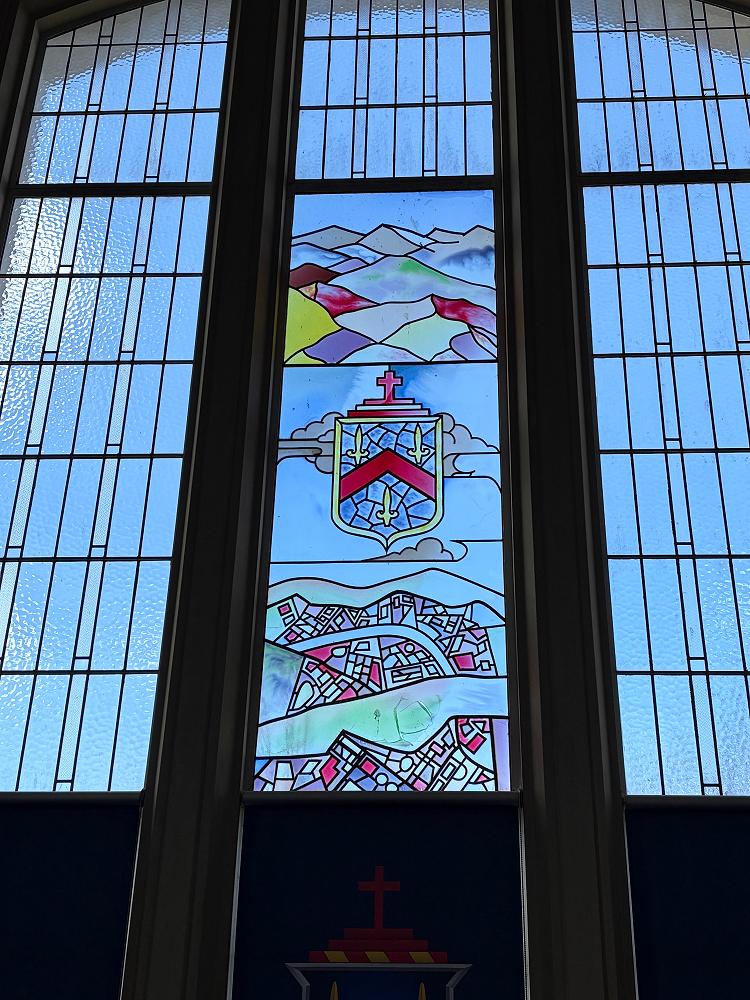
Next week, we are holding a community event at the Waipiata Tavern for the Maniototo boarding families, Old Collegians, and anyone connected to our College. It’s a chance for me to initiate engagement with the community there. It has a full circle feel, if I think back to my time there all those years ago, and a return as the Principal of this special community, which draws together town and country. We are reminded of this whenever we are in our Chapel. It is the heart of our school and a sacred space, which I ask the students to treat with reverence. It holds and reflects the whakapapa of our school. My eye often wanders to the beautiful stained glass window, which places front and centre our historical and current connections to town and country. This adds to our uniqueness and richness. A big part of my job, and a draw in being here, is to support the coming together of these two interconnected spheres.
Belonging matters to me. You will hear me talk about it a lot. All of our students should feel they belong here, and if they do not, they need to talk to me. A feeling of belonging is the essential foundation upon which we build everything else and support our boys to thrive and be successful.
The theme of belonging is one I picked up on at our school assembly this week, when I shared responses from the student survey I initiated at the start of the term. In the survey, they rated whether they strongly agreed or disagreed with this statement, ‘I feel a strong sense of belonging at our school.’ Close to 75% of students rated themselves as a one or two, on a scale of 1-4. This is incredibly positive and speaks to the heritage, culture, relationships, opportunities, and welcoming environment of our school. That being said, my job is to ensure that one hundred per cent of our young people feel that this is their place.
The responses in the survey provided a roadmap to create the conditions by which our students are well placed to foster a sense of belonging. They shared a range of factors that help them feel like they belong. These included friends and mates, brotherhood and community, supportive staff and teachers, welcoming environment, sports teams, arts, and activities, student voice, small school feel and our traditions and identity, cultural inclusion, positive classroom culture, and a sense of pride and home.
Owen Eastwood says this about the power that is unleashed when people feel they belong:
‘When our need to belong in a team is met, our energy and focus pour into the team’s shared mission. We can lock into our role and the tasks we’re being asked to deliver. We are comfortable being vulnerable in our quest to get better. We feel secure enough to help others…We can be ourselves. We feel that we are respected and that we matter. We feel included…our own identity and that of the team happily coexist.’
The key message I wanted the students to take away from the assembly was that belonging is not blind conformity to an organisation or group at the expense of their true selves. As Eastwood rightly argues, organisational and cultural norms coexist with individuality. We want our boys to be themselves and to feel that they are seen and celebrated for that, in all spheres of life at the college, whether in sports, arts, culture, or the classroom. Brené Brown sums it up best when she states that, ‘true belonging doesn’t require you to change who you are; it requires you to be who you are.' This is what we work towards. An unrelenting goal that all of our boys feel like they belong, and as themselves in all their glorious uniqueness.
Nā tō rourou, nā taku rourou ka ora ai te iwi
With your food basket and my food basket the people will thrive
Dr. Aaron Columbus
Principal | Tumuaki
 Open Event Registration - Interested in enrolling?
 Employment opportunities - click if you're interested in working at McGlashan.