

“Not Slytherin, eh?...Are you sure? You could be great, you know, it's all here in your head, and Slytherin will help you on the way to greatness, no doubt about that, no? Well, if you're sure...better be... GRYFFINDOR!” (J.K.Rowling, Harry Potter and the Philosopher’s Stone).
Although the ‘sorting’ of our young people for one of the four houses at John McGlashan is hopefully less fraught, the spirit and enthusiasm for their houses was certainly on show at the school athletics day on Monday. I was asked by students throughout the day what house I was in, and fielded mystified looks when I shared my neutral status. I used the analogy of Dumbledore as Headmaster of Hogwarts, not having official alignment with any house, although clearly having a soft spot for Gryffindor. One of the Year 11s told me I didn’t need to decide today, but should definitely choose Gilray at some point before the year finishes. He had picked up on my public admiration for our second Headmaster, Colin Gilray.
House-based activities contribute to a positive and engaging school culture. They create community and connections and support a healthy competitive culture. Students have the opportunity to develop leadership capabilities and potential. Collectively, this contributes to belonging. I shared this excerpt from Owen Eastwood’s book last term about the centrality of belonging to the experiences of young people and the role it plays in supporting them to thrive in the school environment.
‘When our need to belong in a team is met, our energy and focus pour into the team’s shared mission. We can lock into our role and the tasks we’re being asked to deliver. We are comfortable being vulnerable in our quest to get better. We feel secure enough to help others…We can be ourselves. We feel that we are respected and that we matter. We feel included…our own identity and that of the team happily coexist.’
Several scholars have focused on the key advantages of house systems. They draw attention to its ability to facilitate friendly competition between students, which has the capacity to enhance students’ school engagement and behaviour (Coughlan, 2004; Green, 2006; Nixon, Launay-Fallasse & Watts, 2010). Fincham argues that it helps students to form positive relationships with their peers and students from other year levels, through the vertical nature of the system (Fincham, 1991). These advantages are all enhanced, I believe, when a house system has a heritage element, as ours does.
The Elvidge Cup, which our four houses - Balmacewen, Burns, Ross, and Gilray - compete for, was introduced in 1946. This year we celebrate the eightieth anniversary. The inter-house activities were more ad hoc from our school’s founding in 1918 to the establishment of a structured and formalised competition in 1946. Balmacewen and Burns were the first two houses established when the school opened in 1918, Balmacewen for boarders and Burns for the day boys. Ross was added at a time of accelerated roll growth for the college in the late 1950s, and Gilray more recently, in 2000.
Our newly installed House Walk celebrates the eightieth anniversary of the Elvidge Cup. This is part of a wider strategy connected to our refreshed values that brings to life the concept that ‘you can’t be what you can’t see.’ Central to this is whakapapa and origin stories. Our young people are passionate about their house allegiances, but when I asked them last term to explain the symbols of the crests and who and why the houses are named after certain individuals, their knowledge was limited. Owen Eastwood talks about the importance of a group or organisation connecting to and crafting their ‘Us story’, and how the lack of the ‘Us story’ is a ‘recipe for misalignment and a weak sense of togetherness.’ Making visible the stories of who our houses are named after fosters togetherness, alignment, and a shared sense of belonging and purpose - you can’t be what you can’t see.
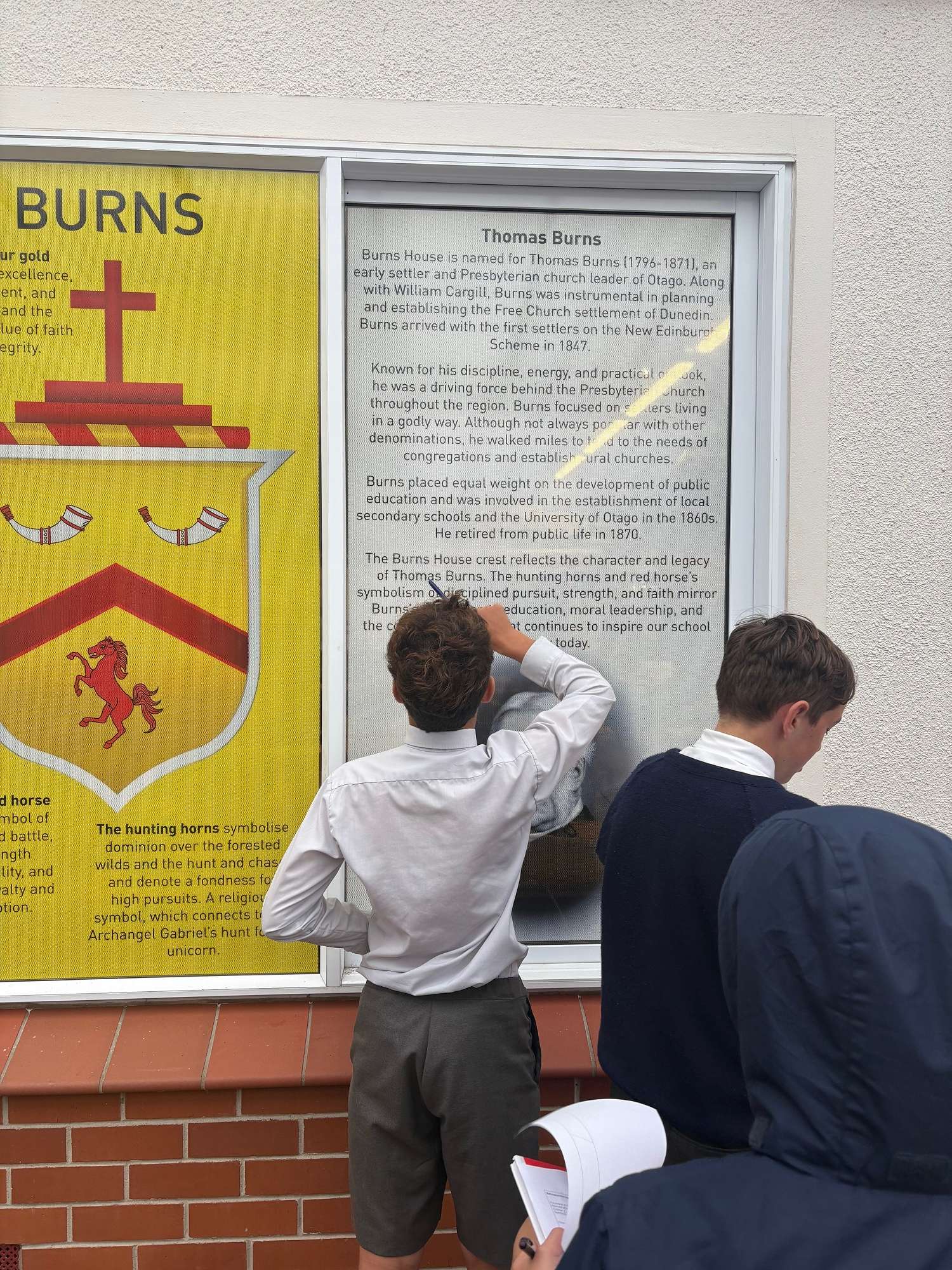
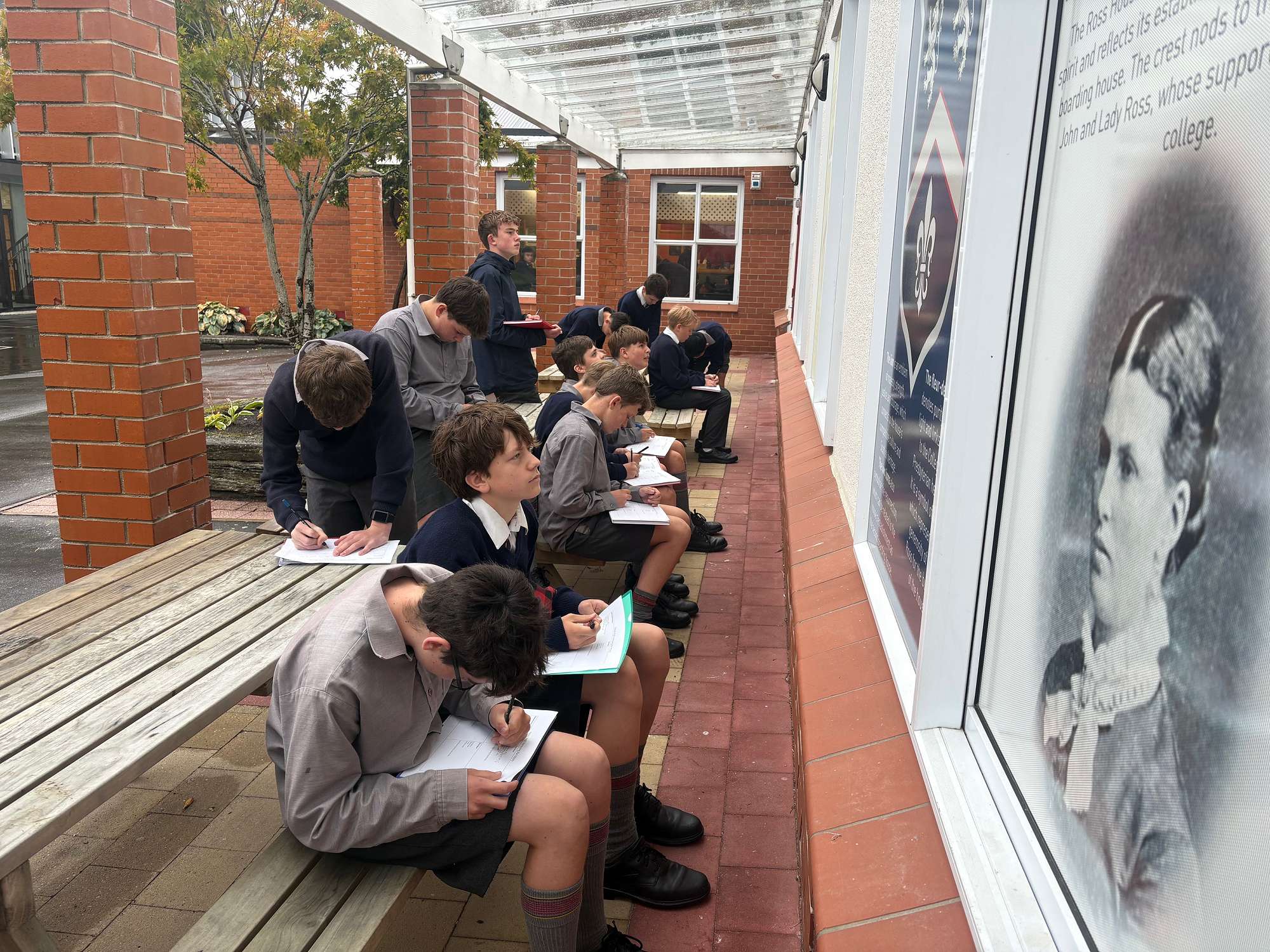
I love that two of the houses are named after wahine toa. Balmacewen is named for John McGlashan’s wife, Isabella, who was highly respected as one of the early matriarchal settlers of Otago. The Balmacewen building opened as the original boarding house in 1919. Ross is named for Lady Margaret Ross, an early benefactor and supporter of the college, alongside other Presbyterian institutions in Dunedin. These are essential stories for our students to know and embrace. We are a school established for the education of boys in the Presbyterian Reformed tradition, as envisioned by John McGlashan, but it was two of his daughters, Agnes and Margaret, who gifted the land and homestead to the Presbyterian Church to realise that vision. The will and purpose of our wahine toa are a key part of our ‘Us story’. It’s been warming this week to see our Year 9s actively engaging with the House Walk in their Integrated Studies class.
Over the past three Friday mornings, during Whānau Time, the students have gathered in their houses to prepare for the house haka competition in Week 7. I enjoy seeing senior students take the lead at these gatherings, alongside the connections being forged across year groups.
In a study at St Margaret’s Berwick Grammar in the UK, Todd Zadow found that the house system and competition brought the school community together and influenced wider engagement at school. It also strengthened staff and student relationships and fostered leadership ambition amongst students. We certainly felt these outcomes on Monday at athletics, and see this manifesting as students prepare and practice for the haka competition.
“Now slip me snug around your ears, I've never yet been wrong, I'll have a look inside your mind. And tell where you belong!” (J.K.Rowling, Harry Potter and the Philosopher’s Stone). While our young people feel a strong connection to their respective houses, which grows their broader connection to the college, collectively, the experiences of the house system contribute to that all-important sense of belonging to the kura. This is a non-negotiable for me, that all students feel this is their place; somewhere they can both be themselves and connect to something bigger than themselves. As I shared with the Year 9s at their weekly Principal’s Assembly, if they are not feeling this, they need to come see and let me know so that we can address that.
Waiho i te toipoto, kaua i te toiroa
Let us keep close together, not far apart.
Dr. Aaron Columbus
Principal | Tumuaki
 Open Event Registration - Interested in enrolling?
 Employment opportunities - click if you're interested in working at McGlashan.