

Boys will be kind
Boys will be themselves
Boys will be vulnerable
Boys will be who we teach them to be
Boys will be held accountable
Boys will be gentle
Boys will be different
Boys will be sensitive
Boys will be more than muscles and silence
Boys will be allowed to cry
Boys will be emotionally articulate
Boys will be responsible for their impact
Boys will be leaders who don’t dominate
Boys will be defined by their own voice
Boys will be authentic
Boys will be brave enough to stand alone
Boys will be loving
Boys will be empathetic
Boys will be the quiet change
Boys will be gentle strength
Boys will be becoming
Boys will be…HUMAN.
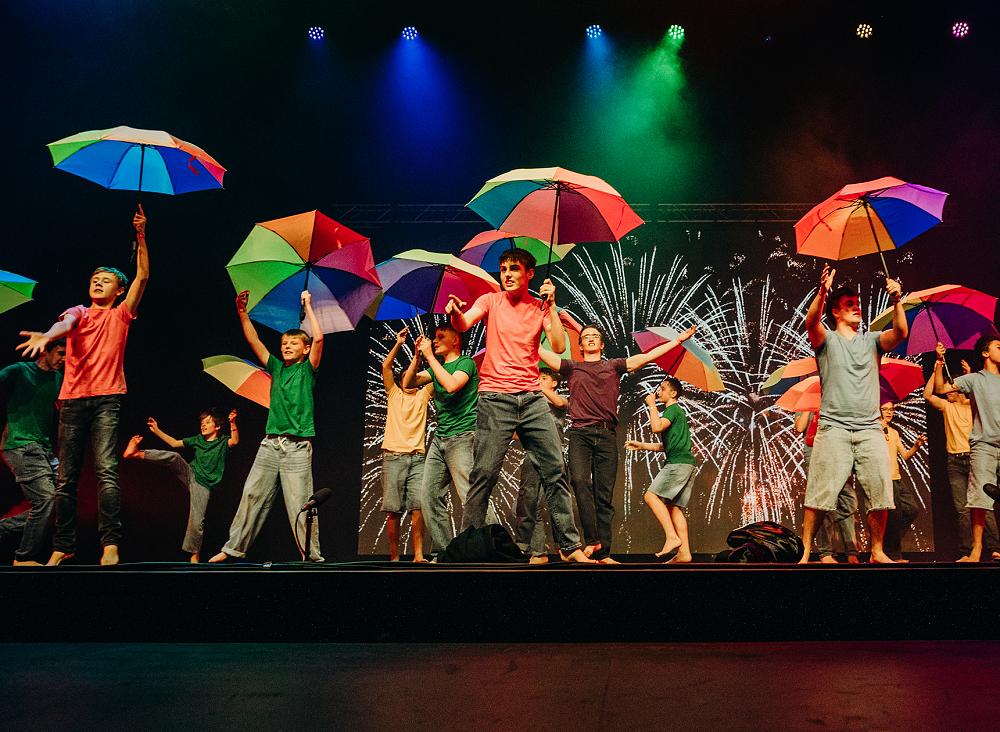
These statements flashed across the big screen at the Regent Theatre on Friday night during our group’s Showquest performance. The theme of our performance was “Boys Will Be…", the key message being that ‘true strength isn't conformity; it's the courage to be authentic. It told the story of a student who, through his own vulnerability, redefines what "strength" and "kinship" mean. It was a powerful performance and resonated strongly with the audience, who erupted in cheers when the protagonist, played by Gus Carr, was lifted into the air by a group of our students as the sequence moved from the murkier themes of the opening to the light and hope of the outro.
Arts and cultural activities have been at the heart of our school since 1918, and continue to be a space where our young people can be themselves, challenge themselves, and thrive. Kimberley Fridd, our Head of Drama, shared that most of the students who performed at Showquest had not engaged in choreographed dancing before. I was floored by this, given the energy and quality of performance on stage.
I mentioned in the foreword last week that the archive centre at Scotch College in Melbourne had given us taonga that the Gilray family had recently gifted to them. Included was the programme for the John McGlashan College Annual Concert in 1934. An annotation was made in the margin about the pipe band’s opening of the show, presumably by Colin Gilray: ‘Very good, but Phil is not a patch on Hugh, only he keeps time much better.’ It shows Gilray’s keen engagement with the boys’ performance. We know that he took a ‘great’ interest in the pipe band. The band notes in the school magazine for 1934 commented that he would be ‘badly missed’ by the band members, as it was through his enthusiasm that many parades were arranged, and his interest which gave the band a start.
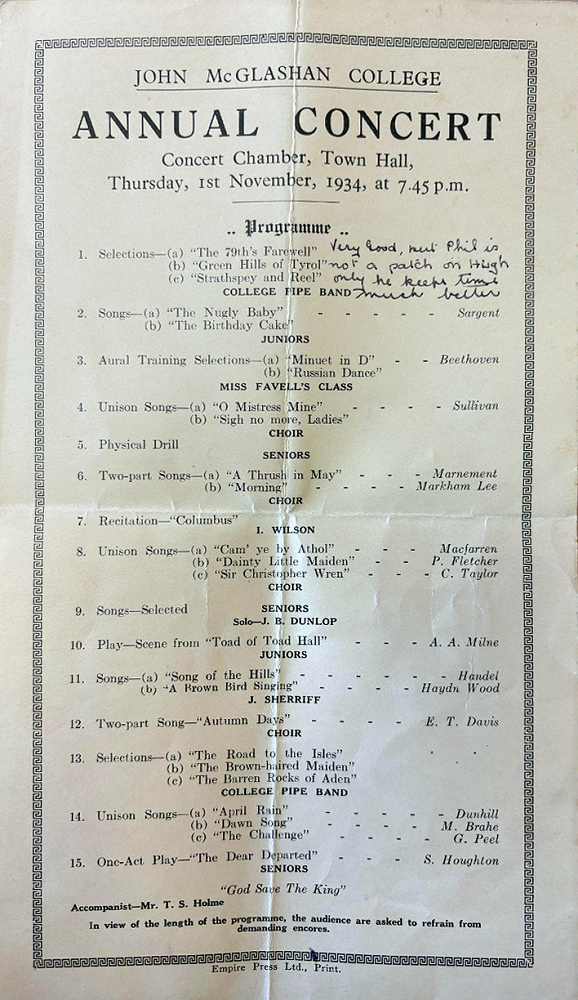
Alongside the programme was a newspaper cutting that reported on the annual concert. It opened with the comment that ‘invariably notable for artistic and dramatic attainment, the annual concert is recognised as fully worthy of its high place in secondary school presentations.’ From the ‘preparatory to the senior departments’, it continued, ‘talent found a pleasurable and wholesome outlet.’ The college’s focus on a liberal and rounded education included the arts, and here in 1934, we see the show as a centrepiece for this, and the students of all ages having the opportunity to shine and thrive on stage. I enjoy seeing these continuities in what we do and who we are today.
Driving home after the show, I reflected on the effusive reception of the audience to our performance, particularly the closing section, when it moved from an oppressive and foreboding feel to a sense of hope. The outro sequence generated an emotional impact on many as our young people closed in as a group with multi-coloured umbrellas, and the song Shake it Out by Florence and the Machine segued to Unwritten by Natasha Bedingfield. The statements that were projected on the screen flipped the script on the perceptions and rules of masculinity that our young people are often exposed to. I felt incredibly proud of the students and staff who had worked so hard over recent months to prepare for this moment, and the courage shown to challenge the flawed and flippant statement ‘boys will be boys’. The performance transformed this into something far more nuanced, hopeful, real, and sustainable.
We’ve opened a conversation in our community about character and the meaning of positive masculinity, which has been underpinned by our refreshed values and mission. Related to character and positive masculinity, we grow young people of integrity, who are respectful, humble, and courageous, who carry themselves with mana and lead with empathy. This is what I saw and heard the boys doing on Friday night. It was powerful, transformational, and showed the way forward. It also provides balance to the darker and pervasive narratives of the manosphere and the closed expectations of masculinity our boys are exposed to.
The Man-Box is an ongoing Australian study that examines the rigid societal expectations placed on boys and men and how these impact health, behaviours, and relationships. It consists of a set of rules that represent a socially dominant form of masculinity that pressures men to act in a certain way. For example, men should figure out their personal problems on their own without asking others for help, and guys should act strong even if they feel scared or nervous inside. The study considers how Australian men perceive social messages that a “real man” thinks and acts a certain way, the degree to which men agree with these messages, and whether men’s attitudes predict a range of behaviours and life outcomes. The most recent study was conducted by surveying more than 3,500 Australian men between the ages of 18 and 45. Two key takeaways of the study were that four in ten men feel pressure to conform to Man-Box rules, and that a quarter of Australian men aged 18 to 30 personally agree with Man-Box rules. That’s a concern.
As a school for boys, we are in a privileged position to create a counter-narrative, to listen to our young people, to encourage their curiosity and asking of questions, and to positively influence their beliefs relating to masculinity. Key to this is the idea that there is no box into which they should fit. Being their authentic selves is the most important thing for them to be. I go back to Owen Eastwood’s comments about belonging and the co-existence of connection and commitment to something bigger than ourselves with the freedom and encouragement to be ourselves.I saw the power of that message manifested at the Showquest performance a week ago. That’s what resonated with the audience. This is the culture we’re strengthening as we continue to nurture character, as we have since 1918.
Dr Aaron Columbus
Principal | Tumuaki
 Open Event Registration - Interested in enrolling?
 Employment opportunities - click if you're interested in working at McGlashan.